
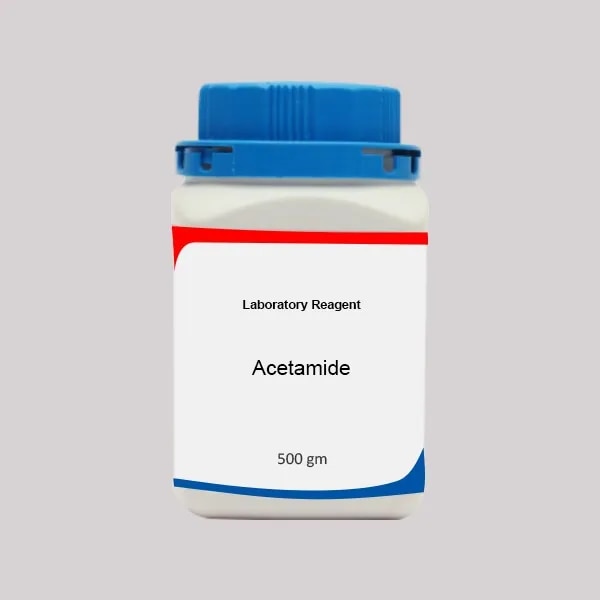
Acetamide
Description
Acetamide (CH₃CONH₂) is a simple amide derived from acetic acid, appearing as a white, odorless, crystalline solid commonly used as a laboratory reagent, solvent, and plasticizer.
Chemical Properties
Molecular formula: CH₃CONH₂ (C₂H₅NO)
Molar mass: 59.07 g/mol
Density: 1.159 g/cm³
Melting Point: 79–81°C
Boiling Point: 221.2°C
Appearance: White crystalline solid; odorless or faint “mousy” odor
Solubility: Highly soluble in water, ethanol, and many organic solvents
Laboratory Uses
Acts as a solvent for organic and inorganic compounds due to high polarity and dielectric constant.
Used as a plasticizer and softener in leather, textiles, paper, films, and explosives.
Serves as a precursor for chemical synthesis (e.g., methylamine), in soldering flux, and as stabilizer for lacquers and explosives.
Integral to biochemical and microbiological acetamide utilization tests for bacterial differentiation.
Safety and Handling
Wear gloves, protective clothing, and eye protection; avoid skin and eye contact.
Acetamide is suspected of being a carcinogen, so exposure should be minimized via good laboratory practices, ventilation, and hygiene.
Avoid ingestion, inhalation of dust, and contact with strong acids or bases.
Acetamide is valued as a versatile, polar solvent and chemical intermediate, but laboratory safety protocols must be followed strictly due to its potential health risks.
Specifications
| Model No. | N-CH1105 |
|---|