
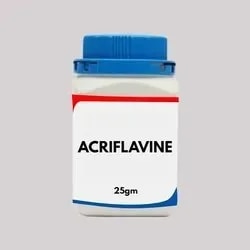
Acriflavin for biochemistry
Description
Acriflavin for biochemistry is a high-purity, laboratory-grade red or reddish-brown crystalline compound commonly used as a fluorescent dye, biological stain, and antimicrobial agent in biochemical and microbiological research.
Chemical Properties
Chemical Name: Acriflavin (often supplied as acriflavine hydrochloride).
Molecular Formula: C₁₄H₁₄N₃Cl.
Molecular Weight: 259.74 g/mol.
CAS Number: 8048-52-0 or 8063-24-9.
Appearance: Red or orange-red crystalline powder.
Purity (Assay): 98.5–105% on dry/anhydrous basis.
Solubility: Soluble in water and alcohol.
Sulphated Ash: Max. 1.0% w/w.
Water Content: Max. 6.5% w/w.
pH (aqueous solution): Neutral to slightly acidic.
Principal Applications in Biochemistry
Fluorescent Staining: Used for fluorescent labeling and staining of nucleic acids (DNA, RNA) and proteins, facilitating their visualization in gel electrophoresis and fluorescence microscopy.
Antimicrobial Agent: Acts as a topical antiseptic and antimicrobial agent for wound treatment, laboratory culture disinfection, and as an antiviral/antifungal compound in various biological models.
Biological Research: Intercalates into DNA, inhibiting bacterial and viral replication, and is used to study nucleic acid behavior, cell cycle dynamics, and gene expression.
Cancer and Drug Resistance Research: Investigated for its ability to inhibit HIF-1α (Hypoxia inducible factor) and sensitize cancer cells to therapy—an emerging area in biomedical research.
Safety and Handling
Acriflavin is poisonous and may irritate eyes, skin, and the respiratory system; appropriate PPE is required during laboratory handling.
Should be stored in a cool, dry place, away from direct sunlight and moisture for maximum shelf life.
Stains skin and surfaces easily and requires care in use and cleanup
Specifications
| Model No. | N-CH1128 |
|---|