
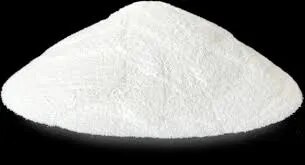
Aluminium fluoride
Description
Aluminium fluoride (
AlF
3
AlF
3
) is a colorless to white inorganic compound made up of aluminium and fluoride ions, widely recognized for its high chemical stability and use in industry. It naturally occurs as the minerals oskarssonite and rosenbergite, and is usually manufactured for industrial purposes.
Chemical Properties and Structure
Formula:
AlF
3
AlF
3
.
Molecular Weight: 83.98 g/mol (anhydrous).
Structure: Features distorted octahedral geometry in its crystal lattice, similar to the rhenium trioxide structure; each aluminium ion (
Al
3
+
Al
3+
) is surrounded by six fluoride ions (
F
−
F
−
), forming a three-dimensional network.
Melting Point: Very high, at approximately 1290°C.
Boiling Point: Around 2350°C.
Solubility: Soluble in water; also forms hydrates such as monohydrate and trihydrate.
Uses
Electrolytic Aluminium Production: The most significant use is as an additive in the electrolytic process for producing aluminium from alumina (about 95% of global aluminium fluoride usage).
Glass and Ceramics: Used to manufacture fluoroaluminate glasses with low optical indices for fiber optics and medical imaging applications.
Catalysis: Acts as a catalyst in organic compound synthesis and polymerization processes.
Steel Industry: Serves as a flux to lower melting points in steel production.
Metallurgy: Helps improve the properties of aluminium alloys.
Physical Properties
Appearance: Odorless, white or colorless, hygroscopic solid.
Density: 3.10 g/cm³ (anhydrous).
Hydration: Can absorb water and exist as monohydrate or trihydrate.
Safety and Handling
Considered non-combustible but can cause irritation to skin, eyes, and respiratory tract; should be handled with standard chemical precautions.
Aluminium fluoride’s high melting point, ionic structure, and reactivity make it essential in aluminium smelting and useful as a catalyst, flux, and component of specialty glass.
Specifications
| Model No. | N-CH1163 |
|---|