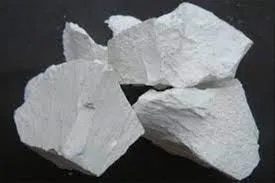
Calcium oxide lumps
Description
Calcium oxide lumps, also called quicklime lumps, are irregularly shaped, hard white to grayish chunks of CaO produced directly after calcination, typically 25–150 mm in size before optional crushing to powder.
Properties
These lumps have the same chemical reactivity as powder form—strongly alkaline, hygroscopic (absorb moisture and CO₂ from air, crumbling to powder), with density ~3.34 g/cm³ and exothermic hydration to Ca(OH)₂—but offer easier bulk handling and storage with reduced dust.
Production
Formed by heating limestone (CaCO₃) in rotary kilns at 900–1200°C (CaCO₃ → CaO + CO₂), yielding lumps that are cooled, screened, and shipped; high-purity lumps minimize impurities like MgO or SiO₂.
Main uses
Lumps are slaked on-site for mortar/plaster in construction, used as flux in steelmaking, soil stabilizer in agriculture, pH adjuster in water treatment, and raw material for chemicals like CaC₂ or bleaching powder.
Specifications
| Model No. | N-CH1523 |
|---|