
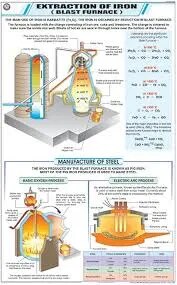
Extraction Of Iron (Blast Furnace) (55x90cm)
Description
The educational chart “Extraction of Iron (Blast Furnace)” (55×90 cm) visually explains the industrial extraction of iron from its ore using the blast furnace process, making it ideal for classroom or lab use.
Core Chart Features and Content
Size and Format: 55×90 cm, typically in a multicolor, laminated format designed for repeated educational use.
Main Diagram: Large cross-sectional schematic of a blast furnace, with labeled zones and components like the input hopper, tuyeres (air blast inlets), area for molten iron (“hot metal”), and slag tap.
Key Input Materials: Shows how the three main raw materials—iron ore (often hematite, Fe₂O₃), coke (carbon), and limestone (CaCO₃)—are added at the top.
Major Reactions:
Combustion: Coke burns in the hot air, creating carbon dioxide:
C
+
O
2
→
CO
2
C+O
2
→CO
2
Reduction to Carbon Monoxide: At higher temperatures, more coke turns CO₂ to CO:
CO
2
+
C
→
2
CO
CO
2
+C→2CO
Reduction of Iron Oxide:
Fe
2
O
3
+
3
CO
→
2
Fe
+
3
CO
2
Fe
2
O
3
+3CO→2Fe+3CO
2
Limestone Decomposition (removal of impurities):
CaCO
3
→
CaO
+
CO
2
CaCO
3
→CaO+CO
2
CaO
+
SiO
2
→
CaSiO
3
CaO+SiO
2
→CaSiO
3
(slag formation)
Process Flow: The iron melts and settles at the bottom; slag floats above and is removed separately.
Educational Points: The chart usually highlights:
The role of coke as both fuel and reducing agent
The function of limestone as a flux for removal of silica impurities
The tapping points for both molten iron and slag
Environmental considerations and by-products (e.g., slag reuse).
Audience and Usage
Aimed at secondary and undergraduate-level chemistry and metallurgy topics.
Helps students visualize the stepwise extraction and purification of iron.
This chart serves as a comprehensive, visually organized teaching aid for understanding the blast furnace process in industrial iron extraction.
Specifications
| Model No. | N-C056 |
|---|


