
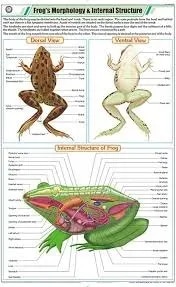
Frog:Skeletal System (55x90cm)
Description
A “Frog: Skeletal System” (55×90 cm) educational chart provides a full-color, labeled diagram of the frog’s skeleton, highlighting both axial and appendicular components for zoology and anatomy instruction.
Chart Features and Major Structures
Size and Material: Measures 55×90 cm, printed in color and typically laminated for durability during repeated classroom or laboratory use.
Axial Skeleton:
Skull: Broad, flat with a triangular cranium, containing the brain and sensory capsules (eye, nasal, auditory).
Vertebral Column: Usually 10 vertebrae—including the atlas (first), typical vertebrae (middle), sacral (eighth), and urostyle (the long, fused terminal bone). Frogs lack a neck and tail vertebrae.
Absence of Ribs: Frogs do not have true ribs; their breathing mechanism relies on other adaptations.
Appendicular Skeleton:
Pectoral Girdle: Includes suprascapula, clavicle, coracoid, and sternum; supports and connects the forelimbs.
Pelvic Girdle: Composed of ilium, ischium, and pubis, fused to support jumping and connect the hind limbs.
Forelimbs: Humerus (upper), radio-ulna (fused forearm bones), carpals, metacarpals, and phalanges (fingers).
Hindlimbs: Femur (thigh), tibiofibula (fused shin), tarsals, metatarsals, and phalanges (toes); elongated for leaping.
Distinctive Features:
Showcases adaptations for leaping (long hind limbs, fused bones).
The chart may note differences with human skeletons, functional roles (jumping, burrowing), and evolutionary significance.
Skull hyperossification and absence of neck/tail are sometimes explained for advanced study.
This chart is ideal for supporting lessons on amphibian anatomy, comparative vertebrate structure, and the role of skeletal adaptations in locomotion and survival.
Specifications
| Model No. | N-C423 |
|---|


